Hilton Head Diminished Value Claims: 2026 Expert Guide
Introduction
You just picked up your Range Rover from a top-tier body shop on William Hilton Parkway, and it looks flawless—but your bank account is about to take a $15,000 hit you didn’t see coming. Most drivers in the Lowcountry believe that once the insurance company pays for the repairs, the ordeal is over. They are wrong. If you’ve been asking, can i claim diminished value after a car accident in the first place, the answer is a resounding yes, and failing to do so is essentially handing a five-figure gift to an insurance company that doesn't have your best interests at heart.
On Hilton Head Island, where luxury vehicles are the standard rather than the exception, the financial stakes of a collision are significantly higher than in other parts of South Carolina. Diminished value isn't just a legal term; it is the cold, hard reality of how much equity you lose the moment an accident is tied to your VIN. This guide will walk you through the 2026 landscape of Claims, loss of value, and the specific strategies required to win in Beaufort County.
- Inherent Diminished Value: The loss of worth because the car now has an accident history.
- Repair-Related Diminished Value: Loss caused by sub-par repairs or non-OEM parts.
- Claim Eligibility: Why 90% of Hilton Head drivers qualify but only 10% actually collect.
Car Worth After an Accident: What Most People Get Wrong
The biggest myth circulating through Sea Pines and Indigo Run is that a 'quality repair' restores a car to its pre-accident value. It doesn’t. Even if the best technician in South Carolina uses gold-plated tools to fix your bumper, your cars worth after an accident has fundamentally shifted in the eyes of the secondary market. Think about it: if you were looking at two identical Porsche 911s at a dealership in Beaufort, and one had a clean history while the other had a $5,000 repair record, which one would you buy? Exactly.
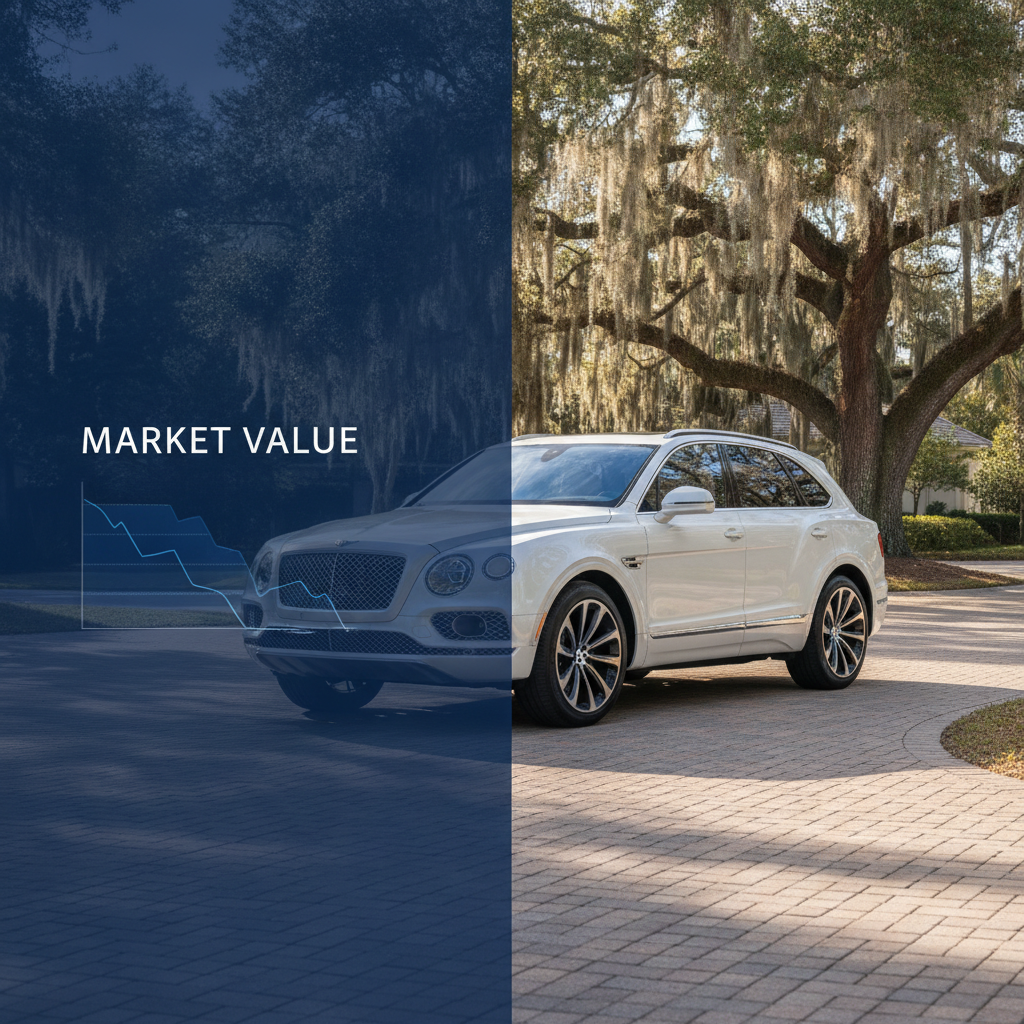
Most people assume that Car depreciation is a slow, steady slope that happens over years of driving. In reality, an accident creates a 'value cliff.' The moment that police report is filed, your vehicle’s resale potential drops by 15% to 35% instantly. This is what we call 'stigma damage,' and it is a real, compensable loss that insurance company adjusters rarely volunteer to pay out. They hope you'll be satisfied with a shiny new coat of paint while they pocket the thousands of dollars in equity you just lost.
What most people get wrong is the belief that they can only claim for physical damage. In 2026, the Accident recovery process must include a recovery of lost equity. If you plan to trade in your vehicle within the next three years, you will feel this loss at the dealership. The appraiser will pull the CARFAX, see the hit, and offer you thousands less than book value. That 'gap' is your diminished value, and you are legally entitled to it today, not three years from now.
The 'Accident Tax' Hiding in Your Vehicle History Report
Your vehicle history report is no longer just a document; it’s a permanent digital scar that acts as a hidden 'Accident Tax' on your net worth. In the high-end Hilton Head market, buyers are incredibly picky. A 'minor' accident on a vehicle history report can be the difference between a quick sale and a car that sits on the lot for months. This digital record ensures that the loss of value follows you across state lines, through every dealership, and into every private sale negotiation.
Loss of Value: Why 'Perfect Repairs' Can’t Save Your Equity
Stop believing the lie that 'good as new' actually exists in the automotive world. While modern technology allows for incredible structural and cosmetic fixes, the economic reality is that a repaired vehicle is a tainted asset. In the world of Auto appraisal, we categorize this as Inherent Diminished Value. It exists regardless of how perfect the repair is because the market perceives a repaired vehicle as inherently more risky than one that has never been damaged.
Consider this: modern vehicles are rolling computers. A collision doesn't just bend metal; it disrupts sensors, compromises factory-sealed welds, and creates micro-fractures that might not manifest for years. Savvy buyers in Beaufort and Ridgeland know this. They aren't just looking at the paint; they are looking at the risk profile. When you try to sell a car with an accident history, you aren't just selling a car; you're selling a 'story.' And in car sales, stories cost money.
"A vehicle with an accident history is like a house with a history of flooding—even if it's dry now, the market will always price in the risk of future problems."
This is why Diminished value claims are so critical for residents of Hilton Head. We drive vehicles that are often under warranty or part of a lease-end strategy. An accident can void certain trade-in guarantees or result in massive 'excess wear and use' charges that are actually just the insurance company’s way of saying your car is worth less. You cannot fix a damaged reputation with a wrench; you can only compensate for it with a check.
Diminished Value Claims: The Truth About South Carolina Law
South Carolina is actually one of the most consumer-friendly states when it comes to Diminished value, but the insurance company won't tell you that. Under South Carolina law, you have the right to be 'made whole.' This means the responsible party (or their insurance) must return you to the financial position you were in the second before the accident occurred. If your car was worth $60,000 before the crash and it's worth $48,000 after the best repairs in the world, they owe you $12,000.
Here is the critical distinction: South Carolina primarily recognizes Claims against the at-fault driver's insurance (Third-Party Claims). If the accident wasn't your fault, the other driver’s insurance is legally obligated to pay for both the repairs and the loss in value. However, if you were at fault, or if it was a hit-and-run, claiming diminished value against your own policy (First-Party Claim) depends entirely on the specific language of your contract—and frankly, most SC policies try to exclude it. This is why determining fault is the first step in your Accident recovery strategy.
- Statute of Limitations: In South Carolina, you typically have three (3) years from the date of the accident to file a diminished value claim.
- Uninsured Motorist Coverage: If you are hit by an uninsured driver, your own 'Uninsured Motorist' coverage in SC often *does* cover diminished value, which is a massive win for local drivers.
- No Minimum Damage Threshold: Unlike some states, SC doesn't require $1,000 or $2,000 in damage to qualify. If there is a loss in value, you have a claim.
The truth about South Carolina law is that it favors the vehicle owner, but it requires the owner to take the initiative. The insurance company is under no legal obligation to offer you a diminished value settlement voluntarily. They will pay the repair bill and hope you go away. If you don't ask, you don't get. It’s that simple.
Diminished Value: How to Calculate It on Hilton Head Island
If you want to know how to calculate diminished value in south carolina, you have to look beyond the generic calculators found online. Hilton Head is a unique market. A 10% value drop on a Ford F-150 in Ridgeland is a very different dollar amount than a 10% drop on a Mercedes-Benz S-Class in Port Royal Plantation. To calculate your loss accurately, you must follow a specific multi-step framework that stands up to insurance company scrutiny.
- Determine the NADA Clean Retail Value: Start with the value of your car immediately before the accident. Use NADA (not KBB) as it is often more respected by adjusters in the Southeast.
- Apply a Damage Multiplier: Most insurers use a base cap of 10% of the vehicle's value, but this is a trap. Depending on structural damage, your real multiplier could be 25% or higher.
- The Mileage/Condition Adjustment: High-mileage vehicles see less diminished value. However, on Hilton Head, many 'island cars' have exceptionally low mileage, which actually *increases* the diminished value loss because the 'clean' version of that car is so rare.
- Market Analysis (The 'Hilton Head Factor'): This is the most overlooked step. You must pull 'comparables' from local dealerships to show what similar 'accident-free' cars are selling for versus 'accident-history' cars.
The formula the insurance company wants to use is designed to save them money. The formula you should use is based on Auto appraisal data and local market realities. If you are dealing with a luxury vehicle, a high-end SUV, or a classic car, the standard formulas will fail you every time. You need a calculation that accounts for the 'Luxury Stigma' prevalent in Beaufort County's high-end zip codes.
Insurance Company Secrets: 5 Reasons They Lowball Your Claim
The insurance company is not your friend; they are a multi-billion dollar industry built on the math of 'paying out less than they take in.' When it comes to Diminished value, they have a playbook of psychological and bureaucratic tactics designed to make you give up. They know that if they can delay you long enough, or sound confident enough in their denial, most people will just walk away with their repaired car and a bruised ego.
The first secret is the 'Standard Offer' tactic. They might offer you a flat $500 or $1,000 as a 'gesture of goodwill.' This is almost always a fraction of what you are owed. By accepting this, you often sign a release that prevents you from seeking the true loss of value later. Second, they will claim that 'if the car is fixed to factory specs, there is no loss.' This is a blatant lie that ignores the economic reality of the resale market. They are betting you don't know the law.
Why the '17c Formula' Fails Beaufort County Drivers
The infamous '17c Formula' originated from a Georgia court case (Mabry v. State Farm) and has become the lazy standard for insurance adjusters across the South. It uses a 10% cap on value and then applies arbitrary multipliers for damage and mileage. For a resident of Hilton Head driving a $100,000 Porsche, the 17c formula might suggest a $2,000 payout, while the actual market Car depreciation is closer to $15,000. This formula is outdated, mathematically flawed, and specifically designed to under-compensate owners of high-value vehicles.
How to File a Hilton Head Diminished Value Claim Successfully
Filing a Hilton Head Diminished Value Claim requires more than just a phone call; it requires a 'Evidence Bomb.' You need to overwhelm the adjuster with so much data that it becomes more expensive for them to fight you than to pay you. The process begins the moment you get your car back from the repair shop. Do not wait. The longer you wait, the more they will argue that 'market conditions' or 'additional wear and tear' caused the value drop.
First, gather your documentation: the original repair estimate, the final itemized invoice, and photos of the damage before it was fixed. Next, you need a professional Auto appraisal. A generic online printout is not an appraisal. You need a certified professional who understands the Beaufort County market to write a comprehensive report that details exactly why your specific vehicle lost X amount of dollars. This report is your primary weapon in negotiation.
- Step 1: Demand the claim in writing. Never do this over the phone where they can 'forget' what was said.
- Step 2: Submit your professional appraisal report along with a formal demand letter.
- Step 3: Reject the first (and likely second) offer. They are testing your resolve.
- Step 4: Mention the South Carolina Department of Insurance if they refuse to negotiate in good faith.
Success in Claims is about persistence. On Hilton Head, we see many claimants win simply because they refused to accept the 17c formula and provided a local market analysis that the insurance company couldn't refute. Remember, you aren't asking for a favor; you are demanding the restoration of your property's value.
Beaufort Secrets: The Key to Maximizing Your Loss of Value
The 'Beaufort Secret' to maximizing your claim lies in understanding the 'Luxury Delta.' In a market like Ridgeland or central Beaufort, car buyers are looking for utility. On Hilton Head, they are looking for perfection. This creates a much larger gap—a delta—between damaged and undamaged luxury goods. To win your claim, you must highlight the 'Lowcountry Premium.' This is a framework I call the Lowcountry Equity Protection Framework (LEPF).
The LEPF focuses on three local factors: 1. The Salt Air Factor: Repaired areas are more susceptible to corrosion in our coastal environment, which further drives down resale value. 2. The Private Community Standard: Dealerships serving areas like Wexford or Palmetto Dunes have much stricter 'Certified Pre-Owned' (CPO) requirements. An accident often disqualifies a car from CPO status, which is a massive, quantifiable financial hit. 3. The Secondary Market Scarcity: Clean-title, low-mileage luxury cars in our area command a premium that the national average doesn't account for.
By framing your loss of value within these local realities, you move the conversation away from 'what a computer says' to 'what a buyer in Beaufort will actually pay.' This is how you turn a $2,000 lowball offer into a $12,000 settlement. You have to speak the language of the local market, not the language of an adjuster sitting in a cubicle in another state.
Expert Guide: Win Your Hilton Head Diminished Value Claim
Winning your Hilton Head Diminished Value Claim is the final step in your Accident recovery. You have already dealt with the stress of the crash and the headache of the repairs. Don't let the insurance company walk away with your equity as their final prize. The 2026 market is faster and more transparent than ever; everyone has access to your car's history, which means everyone knows it's worth less. You deserve to be compensated for that reality today.
The most important piece of advice I can give you is this: Don't go it alone. A professional Auto appraisal is the only way to bridge the gap between 'what you feel' and 'what you can prove.' In 95% of cases on Hilton Head, the cost of a professional appraisal is covered many times over by the increase in the settlement amount. It is the single best investment you can make in your vehicle's financial future.
Your Final Action Plan:
1. Confirm you were not at fault (or have UM coverage).
2. Get your car fully repaired to the best of your ability.
3. Order a certified diminished value appraisal specific to the Hilton Head/Beaufort market.
4. Submit your claim and stay firm. You have the law, the facts, and the market on your side. If you're ready to stop the bleeding of your car's equity, let's get your professional appraisal started today. It’s time to get back what is rightfully yours.
Stop Insurance Steering: Protect Your Car in Beaufort County

Insurance Mobile Apps: How to Avoid the Steering Trap
ACV Dispute: How Beaufort County Auto Appraisal Recovered $8,350 for a Bluffton Client